
The rider's gear


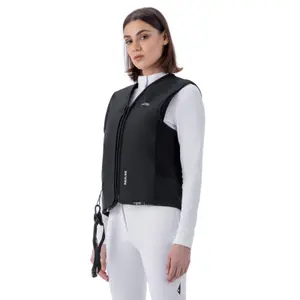
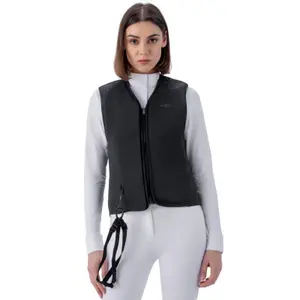


The Protective Gear page brings together body protectors, back protectors, airbag vests, cartridges, tie cords, and helmet cushions, from Swing, Helite, Hit Air, Equiline, Horse Pilot, Horka, or Harry's Horse.
Properly protecting your back and torso means choosing the right standard and size.
Body protector: the three levels
Body protectors are governed by the European standard EN 13158, which defines three levels. The level 1 offers light protection, intended for professional jockeys according to the standard. The level 2, which provides more protection, is suitable for activities considered low risk, and it's the minimum required in some competitions. The level 3, which is the most protective, is recommended for everyday riding, show jumping, cross-country, and young riders. Slimfit vests, like those from Harry's Horse, or the Horka Flexplus for children, adjust to the torso with lacing or side velcro.
Back protection or full vest
Back protection, like the Swing P07, P24, or P19, targets the spine with a shell or articulated plates, being lighter and freer than a full vest. The soft and flexible versions follow the movements of the back. They work well under a jacket or as a base for an airbag but do not protect the chest like a body protector does.
Airbags, cartridges, and cords
The airbag vest, like the Helite Zip'In or Airjacket, the Swing P25 AIR, or the Hit Air Complet, connects to the saddle with a attachment cord. In the event of a fall, the cord tightens and triggers a CO2 cartridge that inflates the vest in a fraction of a second. Each manufacturer has its cartridges, ranging from 30 cc for children's vests to 85 cc and more for larger sizes, which must be replaced with an identical model after each activation. The cord should be checked regularly and fixed to a solid point on the saddle. The airbag can be worn alone or over a body protector, depending on the rules of the discipline.
Helmet foams and adjustment
Inner foams of helmets are replaced to adjust the size or refresh a helmet after many uses, without affecting the protective shell. Any protection, whatever it is, is only effective when well adjusted: it should not float or compress breathing. Other accessories are gathered on the pages gloves, hats and scarves, baggage, whips and spurs, other accessories.
New arrivals and good deals
The new arrivals showcase the latest collections, the promotions highlight discounted items, and the clearance and sales feature end-of-line stock. Items shipped within 24 hours are prepared and dispatched in 24 hours.
Frequently asked questions
What level of vest is suitable for a beginner child?
The level 3, the most protective according to standard EN 13158, is recommended for children, beginners, and cross-country. The vest should cover the torso and back down to the coccyx, without hindering movement.
How to choose the size of a body protector?
The vest should extend down the front to the bottom of the ribs and cover the back down to the coccyx, without touching the saddle when seated. It can be adjusted closely to the body with the side fasteners, without compressing breathing.
How does a riding airbag vest work?
It is connected to the saddle by a cord: in the event of a fall, the separation triggers a gas cartridge that inflates the vest in a fraction of a second. After activation, simply replace the cartridge with the size suited to the model.
Airbag or classic vest: do you have to choose?
Both complement each other: the classic vest provides continuous protection, even from a hoof strike, and the airbag adds cushioning in the event of a fall. In cross-country, many riders wear the airbag over their body protector.
When should a body protector be replaced?
After a severe fall, the foams may have lost their absorption capacity without it being visible. Also replace a vest that has become too small, which no longer covers the intended areas, and adhere to the lifespan indicated by the manufacturer.






