
Horse protection


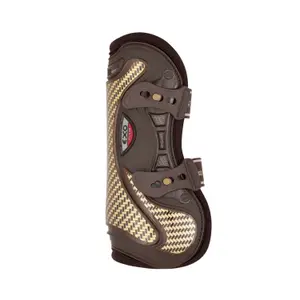


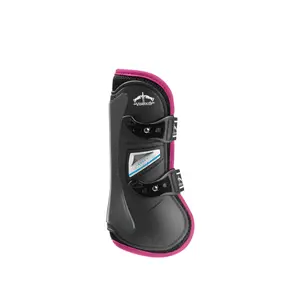


The Protective Gear page brings together what protects the horse's legs and head: open and closed boots, fetlock protectors, bell boots, knee boots, travel gear, hoof boots, fly masks, and fly hoods from LeMieux, Horseware, Premier Equine, Pro-Tech, QHP, Horka, Scoot Boots, Equine Fusion, or Harry's Horse. Whether at work, in the trailer, or in the paddock.
Protecting the horse's legs and head, whether at work or in the paddock.
Open or closed boots and fetlock protectors
Boots protect the tendons at the back of the cannon from injuries that the horse can inflict on itself with its other limbs. Closed boots, like the LeMieux Carbon Air XC or the Horseware, wrap around the whole cannon and are suitable for cross-country and outdoor work. Open boots at the front allow the horse to feel the pole if it touches it, encouraging it to lift its front legs better over obstacles.
Fetlock protectors, like the eQuick eWonder, safeguard the inside of the fetlock on the hind legs. Ventilated models, such as the Premier Equine Air Cooled or Pro-Tech Airflow, reduce the overheating of tendons, as excessive heat weakens the fibres.
Bell boots, tendon boots, and travel protection
Bell boots, like the QHP Technical, wrap around the front hoof and protect the heels and pastern from injuries caused by the hind legs, which are common during jumping, at a gallop, and on heavy ground. The Scoot Boots Endurance pastern protectors fit under the hoof boot to prevent it from rubbing on the pastern. For travel, travel boots, such as the Horka Traveling, cover the limb from the coronet to the knee or hock and cushion impacts against the walls of the trailer during braking.
The tendon boot from Horseware protects this prominent joint from rubbing in the stable as well as in the trailer, and the chest and shoulder protection Q-essentials, made from elastane, prevents the blanket from wearing the coat at the shoulders.
Hoof boots and fly masks: protecting hooves and head
Hoof boots protect the hooves of barefoot horses on hard or stony ground. Scoot Boots, established in 2015 in Tasmania, Australia, offers the Adjust and Regular, which are lightweight and easy to fit, and the Norwegian brand Equine Fusion, based in Stavanger, designs flexible models like the Active Slim. They are to be used for riding out and removed on return, in the stable or paddock.
Against insects, fly masks, such as the LeMieux ArmourShield Pro, the Horseware Rambo, the Harry's Horse Flyshield without ears, or the mesh mask from Horka, protect the eyes, sometimes the ears and nose, without obstructing vision. The fly bonnet QHP Super Bug is worn under the bridle during work.
The horse's gear
The protective gear combines with the rest of the equipment: blankets for the stable and paddock, pads and cushions under the saddle, saddles and girths, bits and bridles, and halters and lunge lines, all found on the horse page.
New arrivals and good deals
New arrivals showcase the latest collections, promotions highlight discounted items, and clearance and sales feature end-of-line products. Items shipped within 24 hours are prepared and dispatched in 24 hours.
Frequently asked questions
Should I protect the hind legs as much as the front ones?
The front legs receive boots to protect the tendons, while the hind legs use fetlock protectors or hind boots, like the Premier Equine Air Cooled. For flatwork as well as jumping, equipping all four limbs limits injuries.
How long should boots be left on a horse?
Only for the duration of the session: remove them as soon as you return to the stable to let the tendons cool and the skin breathe. If left on for hours, they concentrate heat and mud, and can cause rubbing.
How do I clean boots after work?
Brush off the dirt once dry, then rinse the inside with clear water to remove sweat and sand that irritate the skin. Neoprene or foam models often go in the washing machine on a low temperature with closures fastened, then air dry.
How do I choose the size of a hoof boot?
Measure the width and length of the freshly trimmed hoof, under the foot, then compare with the brand's guide. If too large, the hoof boot turns on the foot; if too small, it compresses the heels. A trial walk checks that it stays in place.
Can a fly mask be left on all day in the paddock?
Yes, that's its purpose, as long as it is removed each day to check the eyes and clean the mask. When well fitted, it doesn't rub the eyelids or sag, and its fine mesh keeps the flies away while allowing the horse to be seen.






